
Summary
Step-by-Step E-2 Visa Application Process
Step 1: Document Preparation in Your Home Country (Duration: Approx. 4–8 weeks) Obtain mandatory documents before signing an employment contract or while job hunting.
-
Criminal Record Check: Obtain an official background check from your country’s central agency (e.g., FBI in the US, DBS in the UK) and get it Apostilled (must be issued within the last 6 months).
-
Degree Certificate: Get an Apostille attached to a copy of your 4-year Bachelor’s degree diploma.
-
Others: Valid passport (at least 6 months validity remaining), passport photos, resume, and a Self-Health Statement.
Step 2: Securing Employment & Signing the Contract
-
Interview with language academies (Hagwons) or public schools (e.g., EPIK) through recruiters or job boards, then sign an Employment Contract.
Step 3: Visa Issuance Confirmation Number Application (Duration: Approx. 1–2 weeks)
-
Responsible Party: Employer in Korea
-
The employer submits your original Apostilled documents, employment contract, and school registration documents to their local Korean Immigration Office to apply for the Visa Issuance Confirmation.
-
Once approved, a Visa Issuance Number is issued.
Step 4: Visa Application at the Korean Embassy/Consulate (Duration: Approx. 1–2 weeks)
-
Responsible Party: Applicant
-
Submit the Visa Application form, passport, and the Visa Issuance Number to the Korean Embassy, Consulate, or Visa Application Center in your home country.
-
Once the E-2 visa is granted (or the Visa Grant Notice is issued), book your flight to South Korea.
Step 5: Medical Exam & Alien Registration Entry in Korea (Within 90 days of arrival)
-
Medical Examination: Complete a health checkup—including drug and TB screenings—at a Ministry of Justice-designated hospital.
-
Alien Registration Card (ARC) Application: Reserve an appointment at the local immigration office and submit your passport, medical test results, contract, photos, and processing fee to receive your ARC.
-
MOE Teacher Registration: The employer registers you with the local Office of Education to officially begin teaching.
-
United States: Must submit an FBI Identity History Summary Check (Department of Justice clearance) authenticated with an Apostille from the U.S. Department of State. Academic diplomas must also receive an Apostille.
-
Canada: Must obtain an RCMP fingerprint-based Criminal Record Check. Authentication requires verification through Global Affairs Canada followed by an Apostille (or Korean Consulate authentication depending on processing channels).
-
United Kingdom: Requires an ACRO Criminal Record Check. Both the ACRO check and degree certificate must be legalized via the UK Foreign, Commonwealth & Development Office (FCDO) Apostille service.
-
Australia: Requires an Australian Federal Police (AFP) National Police Check (Standard 10-point check including fingerprints). Documents must be Apostilled by the Australian Passport Office / DFAT.
-
New Zealand: Requires a Ministry of Justice Criminal Record Check, authenticated via the Department of Internal Affairs (DIA) Authentication Unit with an Apostille.
-
Ireland: Must present a Garda Vetting Certificate / Police Certificate authenticated with an Apostille from the Department of Foreign Affairs.
-
South Africa: Requires a South African Police Service (SAPS) Clearance Certificate. Both the police check and degree must be authenticated by DIRCO (Department of International Relations and Cooperation) with an Apostille.
-
Degree Requirement: Must hold a Bachelor’s degree or higher in English Language / Literature / Education from an accredited Indian university.
-
Teaching License: Must hold a valid teaching credential or teacher certification issued by the Indian government or an accredited board.
-
Document Authentication: Police clearance and academic transcripts must undergo verification by the Ministry of External Affairs (MEA) of India and receive an Apostille or consular seal.
-
Valid Passport (at least 6 months validity remaining)
-
Sealed Official Transcripts from an accredited university
-
Signed Employment Contract with a Korean employer (Hagwon or Public School)
-
Completed Self-Medical Health Check Form (followed by an in-person medical scan upon arrival in Korea)
-
Passport-sized photos matching Korean immigration specifications
4. Housing & Flights: What to Expect When Your Academy Sponsors You
-Flights
Most academies that sponsor E-2 visas will cover your airfare, but it’s important to know what “covered” actually means. In the vast majority of cases, this means a one-way ticket only. Round-trip flight support does happen, but it’s the exception rather than the rule. Don’t assume — this is one of the first things you should clarify directly with the academy during your initial contact.
-Housing Support
Academies are required to provide housing support for their teachers, but the way this support is structured can vary. In many cases, the academy provides a housing allowance rather than housing itself: the lease is signed under the teacher’s own name, and the teacher pays rent directly — but the academy reimburses that amount (or a set portion of it) as a housing stipend.
Because the allowance amount differs from academy to academy, you have two options:
- Choose a place above your allowance and cover the difference out of pocket (allowance + salary)
- Find housing that fits comfortably within the allowance amount
If the academy has been operating for a while, it often already has a working relationship with a local real estate agent and a track record of housing past teachers — worth asking about, since it can save you a lot of legwork.
The Biggest Obstacle: Korea’s Rental Deposit System
This is where most first-timers run into trouble. Korean leases are typically one-year contracts, but the required deposit (보증금) can easily exceed ten months’ worth of rent. If you don’t have that kind of lump sum on hand, signing a lease under your own name can be genuinely difficult.
This is exactly why it’s worth asking the academy — during the contact/negotiation stage — whether they’re willing to front the deposit themselves, with the understanding that the deposit is returned to the academy (not you) when the lease ends. Get clarity on this before you arrive, not after.
Maintenance Fees After You Move In
Once the lease is signed, monthly maintenance fees (관리비) are generally your own responsibility based on usage — academies rarely cover this.
The one line item worth paying close attention to is the long-term repair reserve fund (장기수선충당금). Technically, this fee is meant to be paid by the landlord, not the tenant — but in practice, tenants pay it monthly on the landlord’s behalf for as long as they live there. The catch: this money is refundable when your lease ends.
The problem is that most foreign teachers have no idea this fund exists, let alone that they’re entitled to get it back — so it just quietly accumulates in the landlord’s favor, contract after contract, tenant after tenant.
Don’t let this happen to you. When your lease ends, make sure to reclaim your long-term repair reserve fund(Better to keep the monthly receipt) — whether through your academy’s HR support, a Korean friend who can help you communicate with the landlord/agent, or by contacting the real estate agency yourself.
-Severance Pay & National Pension Refund: What You’re Owed When You Leave
Severance Pay (퇴직금)
This one is straightforward and non-negotiable: every employee who has worked in Korea for at least one year is legally entitled to severance pay, regardless of nationality or the reason for departure. This applies to E-2 teachers the same as it applies to Korean employees — as long as you’ve worked full-time for at least one year, typically averaging more than 15 hours per week. The Korea Herald
How much you get: severance is roughly one month’s average wage per completed year of service, calculated from your final three months of pay, and must be paid within 14 days of your last working day. SeoulstartSeoulstart
A few things worth knowing before you sign anything:
- It can’t be baked into your monthly salary. It’s illegal for an employer to claim severance is already included in your monthly pay unless you’re enrolled in a certified retirement pension plan (퇴직연금) — if your director tells you “it’s already in your salary,” ask for proof of enrollment in an approved account (NH, Samsung Life, KDB, KB, etc.). South of Seoul
- You don’t need to apply for it. Once your contract ends (after 1+ year), the employer is legally required to calculate and pay it automatically, within 14 days.
- Late payment isn’t a minor issue for them. Delayed severance accrues 20% annual interest, and non-payment is a criminal offense carrying up to 3 years in prison or a ₩30 million fine. Seoulstart
- If a school stalls or refuses to pay, you can file a free complaint with the Ministry of Employment and Labor — call 1350 for English-language support. Korvia
-National Pension Lump-Sum Refund (국민연금 반환일시금)
This is the part that trips people up, because eligibility isn’t automatic for everyone — it depends on your passport.
How the system works: while you’re employed, contributions are 9.5% of your monthly salary as of 2026, split 50/50 between you and your employer. If you leave Korea before reaching the 10-year mark required for a regular monthly pension, those contributions don’t just disappear — you can claim them back as a lump sum, plus interest. KorviaSoo House
Who actually qualifies? This is where nationality matters. As a general rule, a foreign worker can only get the refund if one of two things is true:
- Korea has a bilateral social security agreement with your home country that includes lump-sum refund provisions. As of 2026, that list includes the United States, Germany, Canada, Australia, France, and about 20 other countries — but notably the UK, Japan, China, and the Netherlands are absent — their agreements are exemption-only, meaning nationals from these countries generally cannot claim the lump-sum refund. SeoulstartKorea Insider Pro
- Or your home country’s pension system offers reciprocal treatment to Korean nationals.
(The blanket “any nationality qualifies” exception applies to E-8, E-9, and H-2 visa holders — not to E-2 teachers, so don’t assume this applies to you without checking.)
Bottom line: don’t guess. Before you count on this money, confirm your specific country’s status directly with the National Pension Service (NPS) — the eligibility list changes, and getting it wrong means planning around money that never arrives.
A few practical details:
- There’s a five-year window to claim after you leave — after that, the payment is simply forfeited, and NPS will not chase you down to remind you. K-Life Choice
- You can submit the application at an NPS office before departure, or mail it from abroad with notarized documents after you’ve already left.
- If you’re departing straight from Incheon, some travelers can complete the process on the way out — NPS runs a counseling desk at Terminal 1 with a foreign-currency payout option through the airport bank booths — worth checking in advance if you want to walk away with the refund the same day you fly out.
- Budget your timeline realistically: figure on 4–8 weeks between submitting your application and the money actually landing. Korvia
One last note for readers: these are the general rules as of 2026, but visa policy, contribution rates, and country eligibility lists do shift — it’s worth adding a line encouraging your readers to double-check their specific nationality against the current NPS list before they build a departure budget around this refund.
5.Finding a School: Public Schools, Private Schools, Academy Chains, English Kindergarden
– Public Schools (EPIK / SMOE / GEPIK)
Public school placement is Korea’s government-run program, and it’s worth understanding the structure before you apply anywhere, because “EPIK” isn’t actually one single program.
EPIK covers most of the country except Seoul — provincial programs like SMOE (Seoul), GEPIK (Gyeonggi), and other regional offices of education hire separately. In practice, this means: ESL Careers
- Want Seoul specifically? There is no direct SMOE application — Seoul positions are filled exclusively through the EPIK system, so you apply through EPIK and select Seoul as your province preference. Korvia
- Want Gyeonggi (the greater Seoul metro area)? That runs through GEPIK, a parallel provincial program with its own application cycle.
- Anywhere else in the country? That’s the main EPIK application.
Eligibility is the same across all of them: citizenship of one of 7 eligible countries (USA, UK, Canada, Ireland, Australia, New Zealand, South Africa), a bachelor’s degree in any field, a 100+ hour TEFL/TESOL/CELTA certificate, a clean apostilled criminal background check, and being within the program’s age limit. Korvia
How to apply:
There are two paths: the official route is directly through the EPIK website, or through an approved third-party recruiting partner (such as Korvia, Reach to Teach, or Adventure Teaching). Applying through a recruiter costs nothing extra — they’re paid by the placement side, not by you — and can meaningfully improve your odds, since EPIK receives well over 4,000 applications for around 1,500 spots each year. ESL CareersESL Careers
Timeline: plan for 4–6 months from your initial application to your first day of school. The spring intake (Feb/Mar start) typically opens around August and closes by October; the fall intake (Aug/Sep start) opens around February and closes by May. Korvia
One important limitation to set expectations correctly: you can only list one location preference on your application (a region, province, or metropolitan city) — you cannot request “urban only” or a specific school, and final placement is decided by the national placement authority based on school needs and applicant volume. If Seoul or Gyeonggi is a hard requirement for you, weigh that against the fact that these are also the most competitive placements. Korvia
-Major Academy(in Korean: Hagwon(학원)) Chains
Hagwons are private academies and operate completely differently from public schools — no fixed intake seasons, no single application portal, and far more variation in quality between individual branches, even within the same chain.
The well-known franchise names you’ll come across:
CDI, CMS Edu, Chungdahm, Avalon, Poly, YBM, Pagoda, and Jongno are among the largest chains with multiple branches nationwide. ChungDahm runs its SPEED curriculum across roughly 20 campuses and is considered one of Korea’s “Big Three” chains; YBM was Korea’s first hagwon, founded in 1961, and now spans language schools, testing centers, and study-abroad programs in addition to teaching branches. KorviaKorvia
Why chains vs. independents matters for your contact approach:
Large chains offer standardized curriculum, in-house training, and more predictable working conditions — independent academies are often smaller and more personal, with more room to shape your own curriculum, but HR processes and reliability vary far more from school to school. Korvia
How to actually reach them: Chains generally don’t run one central “careers” page the way EPIK does. The realistic paths are:
- Direct contact: most chains have branch-level or head-office recruitment contacts — searching “[chain name] + 채용” (hiring) in Korean alongside the English name usually surfaces the right page or email.
- Recruiters/job boards: because hagwons hire year-round rather than on a seasonal cycle, most foreign teachers actually land hagwon jobs through a job board or recruiter rather than cold-contacting a branch (see the job board section below).
- Word of mouth: worth noting honestly — many of the better hagwon jobs are never advertised online at all; when a good teacher leaves, they tend to refer a friend, so the position fills through word of mouth before it’s ever posted. Don’t discount asking current or former teachers directly if you know any. Eslinsider
A geographic note for Seoul-focused readers: if you’re specifically targeting the Seoul metro area, neighborhoods like Daechi-dong in Gangnam-gu concentrate hundreds of academies — including chain and elite independent institutes — that tend to pay above the national average because of the intensity of the local private-tutoring market. That’s a useful area to research if premium hagwon pay is a priority, though the trade-off is a more academically demanding student base. Korvia
-English Kindergartens (영어유치원)
These are a distinct category from after-school hagwons, and it’s worth explaining the difference clearly to your readers since the two get conflated constantly.
“Kindy hagwons” specialize in early-childhood education, usually operating in the mornings and focusing on immersive learning through play, music, and basic communication — rather than the grammar/test-prep focus of after-school academies. English kindergartens typically run roughly 9 AM–2 PM, which is a meaningfully different schedule from the 2–9 PM hours common at after-school hagwons — worth flagging for readers who are weighing lifestyle and schedule as part of their decision. TeastKorvia
Contact and hiring channels for English kindergartens run through the same paths as hagwons generally — direct contact, recruiters, and job boards — rather than a separate dedicated system.
-Verified Job Boards (Seoul Metro / Gyeonggi Focus)
For readers targeting the Seoul metropolitan area specifically, here are the established, widely-used boards:
- Work N Play (theworknplay.com) — a long-running ESL/TEFL job platform connecting native English teachers with positions across Korea, China, and Japan, with heavy representation from hagwons and kindergartens in the Seoul/Gyeonggi area specifically. WorknPlay
- Dave’s ESL Cafe — Korea Job Board (eslcafe.com/jobs/korea) — one of the longest-established ESL job boards, connecting teachers with a wide range of teaching roles across Korea. Listings are searchable and frequently include detailed postings for Bundang, Seongnam, and other Gyeonggi-do locations close to Seoul. ESL
- Korvia (jobs.korvia.com) — recruiter-run rather than a raw listings board, but worth including because of the vetting layer: every listing goes through contract review, employer verification, and placement-history screening before it’s posted, and applying is free for teachers since recruiters are paid by the schools. Useful if your readers want an extra layer of due diligence rather than cold-applying to unknown schools. Korvia Consulting
- ESLROK (eslrok.com) — connects teachers directly with Korean schools, academies, and recruiters across the country, including Seoul, Busan, and Incheon listings. ESLROK
- Seoul Metropolitan Government’s own job page (english.seoul.go.kr) — worth listing precisely because it’s an official government source rather than a private job board, useful for readers who want to cross-check postings against an authoritative source.
A practical note worth adding for your readers: none of these boards are a substitute for checking a specific school’s reputation before signing — recommend they cross-reference any hagwon listing (chain or independent) against teacher review threads before accepting an offer, since board vetting varies widely between these platforms.
6.Where to Look: High-Education-Demand Districts Across Korea
For teachers unfamiliar with Korea, one of the hardest things to judge from abroad is whether a hagwon’s location is actually a good one. There’s a simple shortcut that solves most of this problem: look for districts with a strong “학군” (school-district) reputation. These are neighborhoods where Korean parents specifically choose to live because of education quality — which means dense clusters of well-funded, well-staffed academies, consistent demand for native teachers, and (generally) more stable pay and working conditions than schools in areas with less competitive local demand.
Here’s a breakdown by region.
Seoul — The “Big Three” School Districts
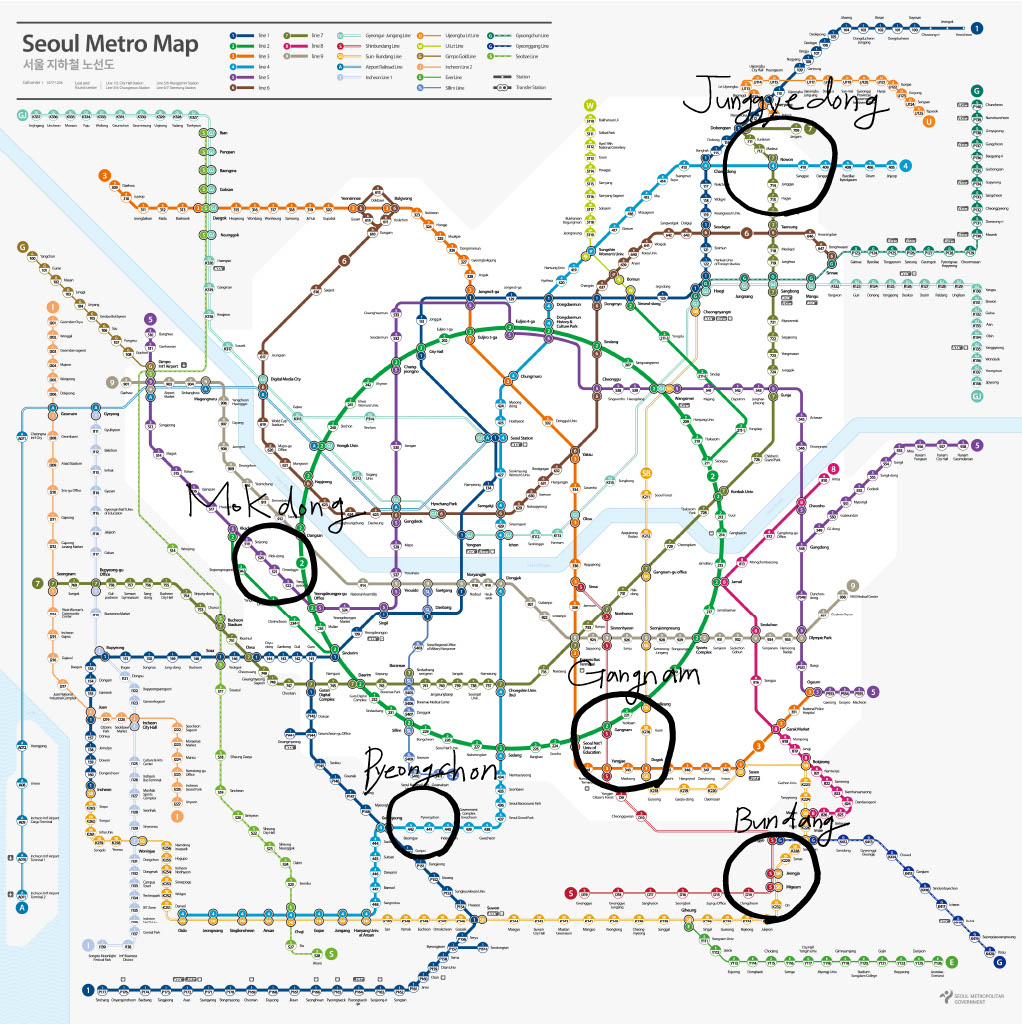
Industry consensus consistently points to the same three neighborhoods as Seoul’s top-tier education districts: Daechi-dong (Gangnam-gu), Mokdong (Yangcheon-gu), and Junggye-dong, specifically the Eunhaeng-sageori area (Nowon-gu).
- Daechi-dong is considered the undisputed center of Korean private education — home to the country’s top exam-prep instructors and the most current entrance-exam information in the nation, with major academy chains treating their Daechi branch as a flagship location.
- Mokdong rivals Daechi in intensity, particularly for elementary and middle-school-level private tutoring, with academies concentrated along its central academy corridor.
- Junggye-dong (Eunhaeng-sageori) functions as the education hub for northern Seoul, drawing strong students from across Gyeonggi’s northern cities (Namyangju, Guri, Uijeongbu) — it’s often described as the most cost-effective of the three major districts, offering strong outcomes without Daechi-level prices.
For a teacher, the practical implication is the same across all three: high concentration of academies, consistent demand for foreign teachers, and — per real estate and industry sources — some of the highest teacher pay in the country, with Daechi-area chain academies reportedly paying in the ₩2.8–4.0M/month range with housing.
Gyeonggi-do (Bundang & the First-Generation New Towns)
If Seoul proper is out of budget or out of reach, Gyeonggi’s “1st-generation new towns” — Bundang, Ilsan, Jungdong, Pyeongchon, and Sanbon — are the next tier down, and Bundang in particular is worth flagging to readers. It’s known for strong transit access to Gangnam, well-developed infrastructure, and a school-district reputation that’s considered top-tier nationally in standardized achievement outcomes, with an especially strong concentration of well-regarded middle schools. Academy clusters are smaller and more spread out than Seoul’s mega-districts — concentrated instead around Seohyeon, Sunae, and Jeongja stations — but the demand and quality bar remain high.
#You can download the map of Seoul Metro at the bottom
Daegu — Suseong-gu
Outside the capital region, Suseong-gu (specifically the Beomeo-dong and Wolseong-dong areas) is consistently named as Daegu’s — and one of the country’s — top education districts, on par with Seoul’s major school-district neighborhoods in terms of the density of high-quality academies capable of preparing students for elite science/foreign-language high schools and top university admissions. For teachers considering a life outside Seoul without sacrificing steady demand and serious academic infrastructure, this is the district to target.
Busan — Haeundae, Namcheon-dong & Daeyeon-dong
Busan’s education-focused neighborhoods are more distributed than a single “big three,” but a handful of areas come up repeatedly:
- Haeundae (Shinsigaji / 신시가지) — a self-contained district offering academy coverage from elementary through high school level.
- Namcheon-dong (Suyeong-gu) — known specifically for its academy density rather than school-district prestige; locals describe it as where the academy infrastructure itself is concentrated, with dozens of math and English academies in a compact area.
- Daeyeon-dong (Nam-gu) — frequently mentioned alongside Namcheon-dong as a strong, education-focused residential area.
Other neighborhoods that come up in local discussion include Dongnae, Sajik-dong, and Myeongnyun-dong, though Haeundae, Namcheon-dong, and Daeyeon-dong are the names you’ll see most consistently.
A note worth including for your readers: these rankings come from Korean real-estate and parenting-community sources discussing where Korean families choose to live for their children’s education — not from a teacher-specific ranking. That’s actually what makes them useful signal: hagwon density and quality tend to follow parental demand directly, so a strong “학군지” is a reasonably reliable proxy for stable hagwon jobs, even though no one is measuring it with foreign teachers in mind.
Closing Thoughts
One last reassurance worth leaving readers with: Korean cities are, for the most part, built on a remarkably similar template. Regardless of which of these districts you end up in, you’ll typically find the same core layout close by — a subway station anchoring the area, a dense cluster of convenience stores, cafes, and restaurants within a five-minute walk, and reliable bus routes filling in wherever the subway doesn’t reach. This consistency is one of the most underrated advantages of teaching in the greater Seoul metropolitan area: once you’ve learned to navigate one neighborhood, you’ve largely learned to navigate all of them.
So while the districts covered here differ in prestige, pay, and academic intensity, the day-to-day experience of actually living in any of them — getting groceries, commuting, finding a decent coffee shop — will feel far more similar than different. Wherever you land within the metro area, convenient, well-connected daily life comes standard.